Why Your Copilot Rollout Stalled, and How Model Choice Restarts It
Eddy Gil is the founder of EGil Marketing, a fractional marketing leadership practice for B2B tech and Microsoft partners, and an international speaker on marketing and AI.
The short version
- Most Copilot rollouts do not fail. They stall, quietly, a couple of months in.
- The stall is almost never a tech or licensing problem. It is an adoption problem.
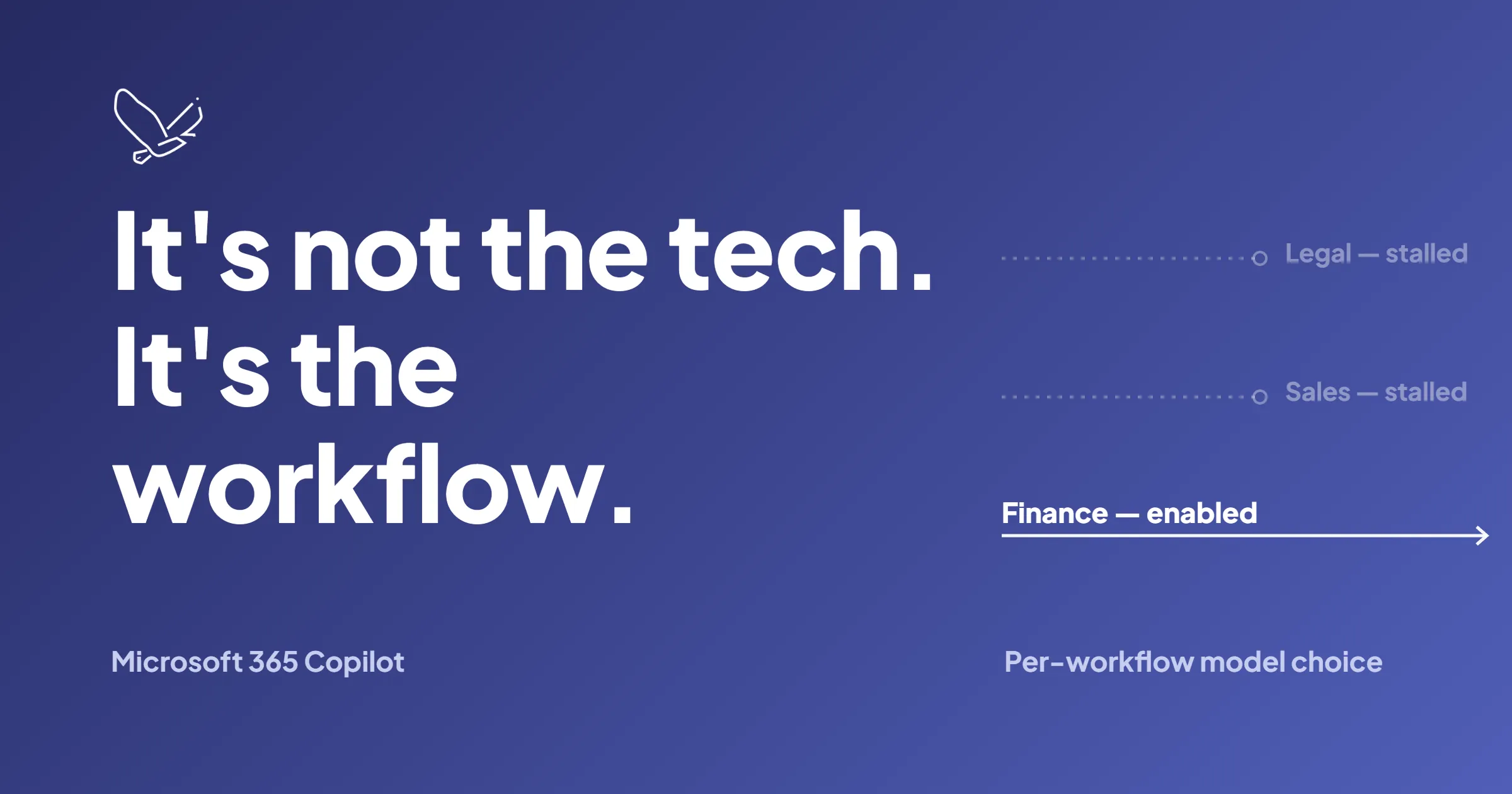
- More training will not fix it. Per-workflow enablement will.
- Model choice gives you a real reason to reopen a stalled account, and this post includes a direct-marketing play to do it.
You sold the rollout. Then it went quiet.
The rollout went fine. First month, there was buzz. People tried Copilot on their email, summarized a few meetings, felt clever. Then the line flattened. Now it is mostly used for tidying up messages, and half the seats you sold barely use it.
Here is the thing you already know in your bones: groundbreaking tech does not get adopted any differently than ordinary tech. People are people. A revolutionary AI assistant still runs into the same human inertia as a new expense app, and no amount of “but this one is different” changes that. Copilot is not exempt, and the stall proved it.
Nobody is angry, though. That is the tricky part. A stalled Copilot rollout does not blow up. It just goes quiet, and quiet is easy to ignore until the renewal shows up.
The status quo everyone recognizes
Here is the shape of it, because it is the same story in most accounts. The company bought a block of seats. IT deployed it. There was a launch email, maybe a lunch-and-learn. Usage spiked, then decayed as the novelty wore off and daily habits pulled everyone back. Now the client is quietly wondering whether Copilot was worth it, and you, the consultant who sold it, need a reason to get back in the room that is not “have you tried using it more?”
Because that is the move most people reach for, and it does not work. Another webinar, a fresh prompt list, a nudge from IT. Usage bumps for a week, then flattens again. It flattens because the stall was never about training. It is organizational. No manager is modeling it. It is not wired into any actual workflow. Permissions are often off in one direction or another: too tight for Copilot to surface anything useful, or too loose for people to trust what it does. And the value gap is real across the whole market: 37% of surveyed organizations attribute at least some EBIT impact to AI, but only about 6% clear McKinsey’s high-performer bar. The difference is not the tech, it is enablement, and generic enablement does not move that number, so it will not move your client’s either.
“We already did training. Why would more of it work now?”
It will not, if it is the same training. Prompts, Copilot Skills, and agents are per workflow, which means training has to be too. A finance team closing the books and a sales team writing follow-ups do not need the same session. One big generic webinar teaches everyone a little and nobody enough. That is a big reason the line flattened.
The thing that actually changed
Then something real happens. Copilot now has model choice, Claude or GPT, newly generally available in the apps your client already uses. That matters for a restart in two specific ways.
First, it kills an objection you probably never heard out loud: the quiet worry that they bought the wrong tool, or one that was about to fall behind. “We committed to Copilot and now the models are moving on without us” is exactly the kind of doubt that keeps a client from investing more. Model choice answers it. They are not stuck on one lab’s pace anymore.
Second, and this is the practical part, it gives you a legitimate, non-desperate reason to call. “Here is what is new, let us put it on one real workflow” is a very different conversation from “please use your licenses more.” One is a reason to meet. The other is a reminder of a purchase they regret.
“Isn’t ‘we added a new model’ just a gimmick to reopen a stalled account?”
It would be, if you led with the model and stopped there. You do not. You lead with the change because it is a real reason to talk, and then you do the unglamorous work: pick one workflow, wire Copilot into it, and measure it. Model choice opens the door. The workflow is what keeps it open.
What restarting a stalled Copilot rollout looks like
The re-launch that works is not “use it more.” It is “here is what changed, and here is one workflow we are going to make undeniable.” You get the meeting with the news. You make it stick with per-workflow enablement, one team and one job at a time, measured so the value is visible. Do that, and the account re-activates. You have an expansion path instead of a churn conversation, and the client has a reason to believe again.
What this means for you
If you are a consultant (SI, MSP, advisory): your stalled Copilot accounts are not dead. They are waiting for a reason, and model choice is a good one. Lead with the change, re-scope one workflow per team, and measure it. That is a re-activation motion you can run across your whole book, not a one-off.
If you are a product company (ISV, SaaS): the same lesson applies to your lapsed users. A genuine product change is permission to re-engage. “Please come back” is not. Ship the change, then give people one concrete workflow to come back for.
The play: a direct-marketing campaign to your dormant accounts
This is a marketing play, not a delivery plan. The client already exists, so the motion is direct marketing: a targeted campaign to a warm list you already have, aimed at landing the re-launch engagement.
- Build the list. Pull every client sitting below real adoption and rank by seats bought. That is your segment, and it is already warm.
- Warm the field before you reach out. Post the model-choice angle on LinkedIn a few times first, so it shows up in your dormant clients’ feeds. Then your outreach is not the first they have heard of it, it is the third, and a cold message becomes a warm follow-up to an idea already sitting in their head.
- Reach out, news not pitch. A short, direct message to each: “Copilot just added model choice, Claude and GPT. Worth two minutes to show you what it changes for your team.” Lead the outreach and the follow-ups with the hooks they feel: the seats they are already paying for and not using, the “our tool is behind” worry this quietly fixes, the one workflow you could make undeniable in a month.
- Point it all at the proposed item. The call to action is a scoped, paid re-launch: put model choice and one real workflow to work, with a measure attached. That offer is what the campaign exists to sell.
- Sequence it. One touch is a reminder, three is a campaign. Space them out, vary the angle, and let the clients who are ready raise their hand.
The delivery underneath (per-team sessions, wiring Copilot into one workflow, measuring at 30 and 60 days) is what you sell them into, and it is worth naming as proof you have a real plan. But the play here is the marketing that earns the yes.
That direct-marketing motion, turning a Microsoft launch into re-activation revenue from clients you already have, is exactly what I build with Microsoft partners. If you have a book of stalled Copilot accounts and no campaign pointed at them, that is the gap I close. Worth a conversation.
Sources: McKinsey, State of AI (Aug 2026); Microsoft Learn, Copilot in Microsoft 365 apps with Anthropic models.
Why do Microsoft Copilot rollouts stall?
Usually because adoption is treated as a deployment problem, not an organizational one. Seats get bought and turned on, but Copilot is not wired into real workflows, managers do not model it, and training is generic. Usage spikes at launch and decays.
What is a good Copilot adoption rate?
There is no magic number, and chasing a percentage misses the point. Healthy adoption looks like specific teams using Copilot inside specific weekly workflows, with measurable output, rather than a broad login count that looks fine and means little.
How do you restart a stalled Copilot rollout?
Give people a real reason to look again (model choice is a current one), then do per-workflow enablement: one team, one weekly job, Copilot wired in, results measured. Expand from each win.
Does model choice actually help adoption?
Indirectly, and usefully. It removes the "our tool is already behind" doubt and gives you a genuine reason to reopen the conversation. It is the door, not the whole room. The workflow work still has to happen.
How long does a Copilot re-launch take?
In my experience, plan for 60 to 90 days. That is enough time to run per-team sessions, wire Copilot into a real workflow, and measure results at 30 and 60 days before expanding.
Who should own Copilot adoption?
Not IT alone. Adoption is a business-process question, so it needs a business owner (often closer to operations than to the help desk) who can decide which workflows change and hold teams to using it.