Claude vs GPT in Microsoft 365 Copilot: Why the Choice Matters More Than the Winner
Eddy Gil is the founder of EGil Marketing, a fractional marketing leadership practice for B2B tech and Microsoft partners, and an international speaker on marketing and AI.
The short version
- The AI model leaderboard keeps changing hands, and your clients know it. That uncertainty is why half-started Copilot projects stall: nobody wants to back the lab that loses.
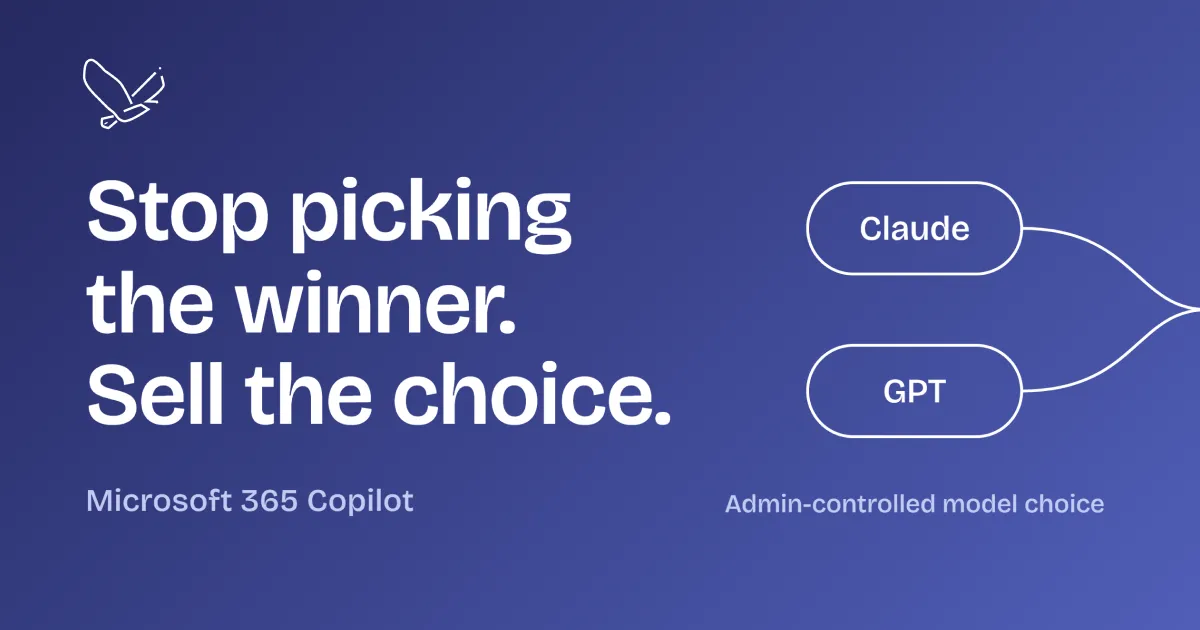
- For a Microsoft shop, that bet no longer exists. Microsoft 365 Copilot now lets you choose between Anthropic’s Claude and OpenAI’s GPT, inside the apps your client already pays for.
- The move is not to pick the “right” model, it is to sell the choice and drive adoption. For a client who already deployed Copilot, the governance foundation is banked, so the whole game is getting idle seats used, and model choice is the fresh reason to reopen the account.
- Below: two campaigns you can run from this one announcement, for your dormant Copilot clients and for your other dormant accounts, the past clients you did any project for who never bought Copilot.
The Claude vs GPT question your clients keep asking
A client asks whether they should standardize on OpenAI, switch to whatever topped the benchmarks last week, or just wait until the dust settles. You give an honest answer, which is that you are not sure either, because the honest answer changes every quarter. Meanwhile the Copilot licenses they bought last year are barely getting touched, and instead of thinking they need to improve adoption, they’re thinking we wasted a lot of time and money.
That call is a gift. Most consultants treat it as a trap.
Here is the thing most partners are wrestling with right now. Your clients are not paralyzed by which AI is best. They are paralyzed by how fast “best” keeps moving. OpenAI just rolled out GPT-6 Astra, and overnight the top of the leaderboard changed hands again. In 2025, Anthropic reached 40% of enterprise LLM spend while OpenAI fell to 27%, cut nearly in half from 50% in 2023. When the lead trades hands that fast, “let’s wait and see” starts to feel like the responsible choice. It is not. It is just expensive. 29% of decision-makers are very concerned about depending on a single AI vendor, and 27% call themselves completely reliant on their primary one. That is the real emotion under the stall.
So the client asks you to make the call, and you feel the squeeze. Recommend one lab and you might look wrong by the next release. Tell them to wait and the seats keep gathering dust while enterprise spending on generative AI more than tripled in a single year, to $37 billion. Either way you are the consultant who did not have an answer, which is the one thing that gets you uninvited from the next conversation.
“But my clients are on Microsoft. They don’t sit around choosing models.”
Right, and that is exactly why this is safe now. You are not asking them to pick a lab and live with it. Microsoft put the choice inside Copilot. Microsoft 365 Copilot now lets your client use Anthropic’s Claude or OpenAI’s GPT across the apps they already have, Word, Excel, and PowerPoint, plus Copilot Chat, Researcher, and Copilot Studio. Outlook is not on the list yet. The bet you were afraid to make, Microsoft made optional.
This is where a lot of consultants still reach for the wrong pitch. They want to argue models. Claude is better at long reasoning, GPT is better at this other thing, here is a comparison table. That is a fun debate and a terrible sale. Your client does not want a model bake-off. They want to stop feeling like every AI decision is a coin flip they will regret. In a16z’s survey of 100 enterprise CIOs, 37% were already using five or more models, up from 29% the year before, because they worked out that the debate is the wrong debate. Using more than one is the normal state, not the clever hedge.
Microsoft 365 Copilot model choice: stop selling the model, sell the choice
The pitch that lands is not “Claude is winning.” It is “you no longer have to care who is winning.” Microsoft swaps the frontier models in behind Copilot, so your client always has access to strong ones without re-platforming every time the benchmarks shuffle.
And here is the part that makes Copilot a safe long-term bet, not just a model of the month. Turning Copilot on properly means cleaning up permissions, fixing the oversharing nobody wanted to look at, and making the data findable through Microsoft Graph. That work compounds, and the model race cannot take it away. Two things follow from that.
If you already deployed Copilot for a client, that hardening is banked, so you do not re-sell it, you use it: their dormant seats are sitting on a foundation you built, and the whole job is getting them used. And if you did some other project for them, a SharePoint intranet, a governance engagement, or anything else, and they never moved on Copilot, be honest that Copilot raises the bar.
It demands stronger governance and security than most projects touch, and it has to run company-wide. Not because Copilot breaks permissions (it doesn’t, it only returns what the person could already open), but because the scope is set by content, not headcount. What a licensed user can reach is every site, channel, and shared link that’s ever been opened up to them, and almost nobody has that mapped. You find the edge by auditing for it, and that audit runs across the whole estate.
That is not a reason to skip the client, it is the reason to call them: you already have the relationship and know their estate, so you are the natural partner to take them there, with model choice as the timely reason to start.
Put plainly: your client is not buying a horse. They are buying the track. Horses come and go. The track keeps paying.
“Isn’t switching on a third-party model like Claude a new security headache?”
It is a governance decision, and this is where you get to be the adult in the room, honest instead of hand-waving. Anthropic runs as a Microsoft subprocessor under the Product Terms and DPA, and the Customer Copyright Commitment applies, so this is not some ungoverned bolt-on. But be straight about two things before you flip it on. Anthropic’s models sit outside the EU Data Boundary, so data can leave the EU, and there is a separate data-retention model tier that runs under Anthropic’s own terms rather than your Microsoft agreement. For a North American commercial tenant, the master setting is on by default already. For an EU, UK, or government-cloud client, it is a decision with a data-residency review attached. Walking a client through those two facts calmly is worth more than any feature you could demo.
The consultant who leads with this does not just win the AI conversation. They get a reason to call the accounts that went quiet. And they need one, because the value gap is real. 37% of surveyed organizations attribute at least some EBIT impact to AI, but only about 6% clear McKinsey’s high-performer bar, which means most of your stalled clients are stuck in that gap, on licenses that have not paid off yet. That is not a reason to avoid the conversation. It is the conversation. “You bought Copilot, it stalled, and here is a concrete thing that has changed since” is one of the easiest re-engagement emails you will ever send.
And the uncomfortable part, since we are being honest: if you are not putting model choice in front of your clients, someone else will. There is another Microsoft partner circling that account who would love a reason to start a conversation. Model choice is a good one. Do not hand it to them.
What Copilot model choice means for consultants
This is a re-activation motion for SIs, MSPs, and advisory partners, not a net-new pitch. Your dormant Copilot accounts just became warm again, because something genuinely changed. Lead with the choice and the governance, not the model comparison. Sell the outcome, a workflow that works on a platform that will not strand them, instead of a bet on a lab. And move before the partner down the street does.
The play: two re-activation campaigns from one announcement
This is a marketing play: direct outreach to warm lists you already have. Model choice gives you a reason to reopen two different kinds of past client. Run whichever fits your book, or both.
Campaign 1, your dormant Copilot clients. The governance foundation is already banked, so do not re-sell it. This is an adoption play: get the idle seats used, with model choice as the fresh reason to look again.
- Pull the accounts with Copilot seats bought and barely used.
- Send one line: “More choice. Same cost. Copilot now lets you pick Claude or GPT. Worth two minutes to see what it changes for your team?”
- Offer a 30-minute session: check their model settings and pick one high-value workflow a stronger model actually improves.
- Scope that workflow as a small paid engagement, measure it, and reopen the adoption conversation.
Campaign 2, your other dormant accounts. These are past clients you did some project for who never moved on Copilot. You have the relationship and you know their environment, which makes them warm. Be honest, though: Copilot demands stronger, company-wide governance than most projects touch, so there is real readiness work to do, and you are the natural partner to do it. (If that past project happened to be a SharePoint intranet or a governance engagement, you have an even bigger head start.)
- Pull the past clients you did any project for, who never moved on Copilot.
- Send the line only you can send: “We already know your environment, and Copilot is worth a serious look now. It takes real governance to do right, but you have a partner who knows your estate, and it runs Claude or GPT so you are not betting on one lab. Worth a conversation?”
- Offer a Copilot readiness review that uses what you already know about their estate and scopes what company-wide governance still needs.
- Scope that readiness plus a first use case as a proper engagement, not a favor.
Two lists, one announcement, and you are the partner who already knows their estate.
That is the kind of motion I build with Microsoft partners: taking whatever Microsoft just shipped and turning it into a client conversation you can actually win, then a campaign that runs without you babysitting it. If your past clients are sitting in a spreadsheet doing nothing and you would rather have a marketing engine than a pile of good intentions, that is the job I do. Worth a conversation.
Sources: Menlo Ventures, State of Generative AI in the Enterprise (Dec 2025); a16z, AI Enterprise 2025 (Jun 2025); Zapier AI vendor lock-in survey (Apr 2026); McKinsey, State of AI (Aug 2026); Claude models in Microsoft Foundry (Microsoft Learn); Microsoft Learn, Copilot in Microsoft 365 apps with Anthropic models; Anthropic models in Microsoft Online Services (subprocessor and data terms); Microsoft 365 Copilot pricing.
Can you choose between Claude and GPT in Microsoft 365 Copilot?
Yes. Microsoft 365 Copilot supports Anthropic's Claude models alongside OpenAI's GPT, generally available in Word, Excel, and PowerPoint, plus Copilot Chat, Researcher, and Copilot Studio. Outlook is not on the list yet. Your admin decides which providers are enabled. (As of September 2026 that means the current Claude and GPT model families; Microsoft refreshes the exact versions often, so check the model picker for what is live.)
Is Microsoft Copilot locked to OpenAI?
Not anymore. It launched on OpenAI models, but Microsoft added model choice, first in the Researcher agent and Copilot Studio in late 2025, then across the core apps through 2026.
Which model should I use in Copilot, Claude or GPT?
It depends on the task, and that is the point, you can switch instead of committing. A common pattern is trying the stronger reasoning model on complex drafting and analysis, and the default on everyday work. Test on your real workflows rather than trusting a benchmark.
Is using Claude in Microsoft 365 Copilot secure, and how is data handled?
Anthropic runs as a Microsoft subprocessor under Microsoft's Product Terms and DPA, with the Customer Copyright Commitment applying, and admins control access from the Microsoft 365 admin center. Two caveats matter for regulated clients: Anthropic models are excluded from the EU Data Boundary, so data can be processed outside the EU, and a separate data-retention model tier runs under Anthropic's own terms rather than your Microsoft agreement. Check both before enabling it in the EU, UK, or a government cloud.
Does model choice cost extra, or need a specific license?
No extra charge for the choice itself, but it needs a paid Microsoft 365 Copilot license, and it is not on the free tier. The figures here are US pricing in USD. The Microsoft 365 Copilot Business add-on is $18/user/month, a promotional price through December 2026 (list is $21), on a qualifying Business Basic, Standard, or Premium plan. You can also get it bundled, for example Business Standard with Copilot at $23.50/user/month. One thing SI and MSP partners need to watch: Copilot Business caps at 300 seats, so above that clients move to Microsoft 365 Copilot at $30/user/month. (Pricing varies by region and currency, runs on an annual commitment, and changes, so check Microsoft's pricing page for your market.)
How do I turn on Anthropic models in Microsoft 365 Copilot?
An admin enables the provider in the Microsoft 365 admin center under Copilot settings, using the AI Administrator role. The master subprocessor setting is on by default across commercial cloud but off in the EU, EFTA, UK, and government clouds, so check yours. From there you can scope access to everyone or to specific users and groups, though granular per-user scoping was still rolling out, so confirm what your tenant supports.